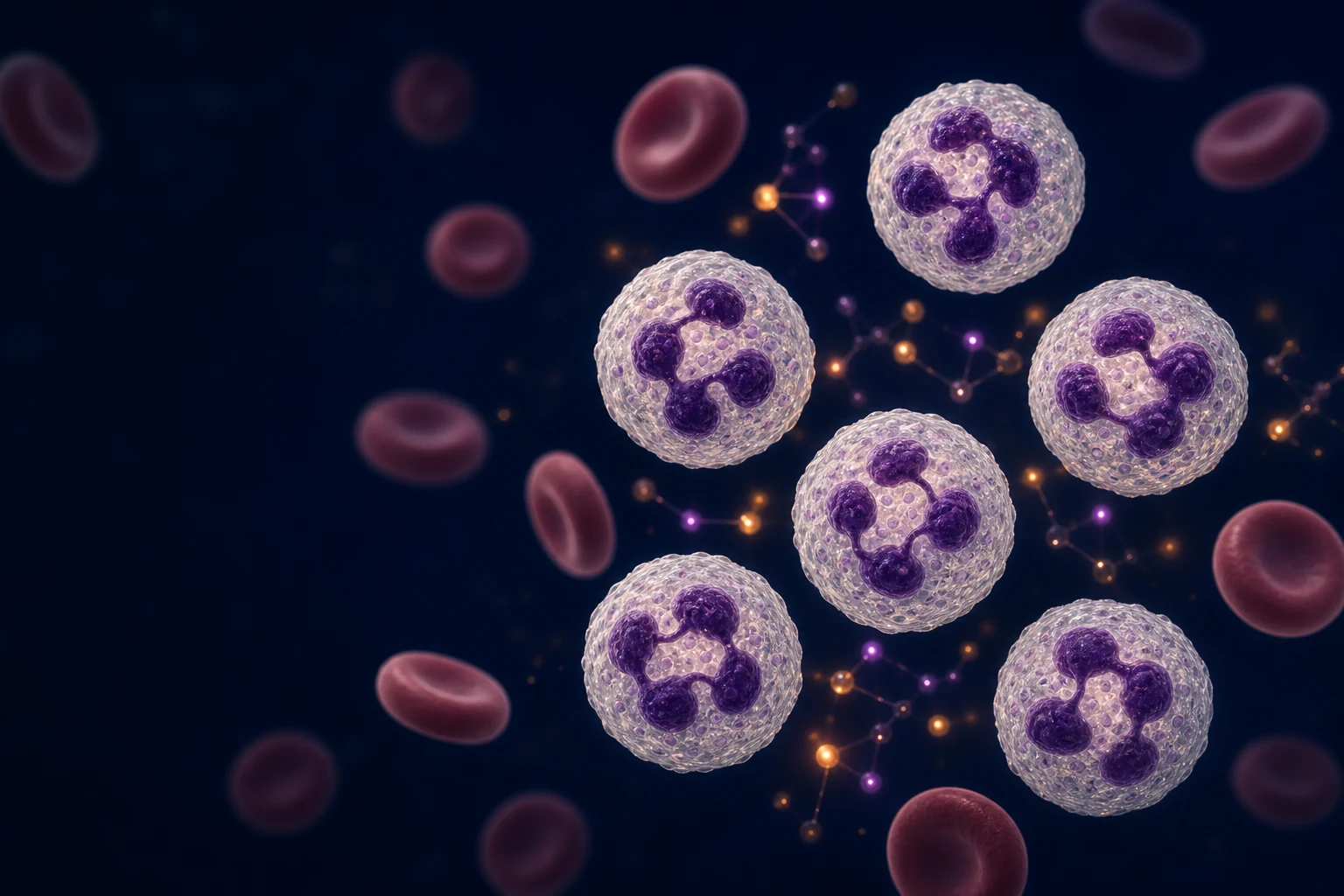
Vitamin C is one of the most recognised nutrients in medicine. Most people associate it with preventing scurvy, supporting wound healing, or helping the immune system. Less well known is the fact that some immune cells actively concentrate vitamin C to levels far higher than those found in the circulation.
Neutrophils, the most abundant circulating white blood cell, can contain intracellular vitamin C concentrations that are approximately 10–100 times greater than plasma concentrations. This observation has been reproduced repeatedly in human studies and raises an interesting biological question: why does a cell invest energy transporting and storing such large amounts of vitamin C?
The answer lies in the way neutrophils destroy pathogens.
The neutrophil: a professional killer
Neutrophils are the first responders of the innate immune system. Within minutes to hours of tissue injury or infection they migrate into affected tissue, identify pathogens and initiate antimicrobial activity.
One of their primary defence mechanisms is the respiratory burst. During this process, activation of NADPH oxidase generates large quantities of reactive oxygen species (ROS), including superoxide and hydrogen peroxide. These molecules are highly effective at damaging bacterial proteins, lipids and nucleic acids.
The respiratory burst is one of the most important antimicrobial systems in human biology. Individuals with chronic granulomatous disease, who cannot generate an effective respiratory burst, suffer recurrent and often severe infections despite having normal numbers of neutrophils. The ability to generate oxidants is therefore critical to host defence.
However, it creates a second problem. The same molecules that damage pathogens are also capable of damaging the neutrophil itself.
Oxidative stress is not just for the pathogen
Reactive oxygen species are often discussed in the context of ageing and chronic disease, but their physiological role is more complex than simply being "bad". ROS are essential signalling molecules and are also deliberately produced by immune cells as antimicrobial weapons.
The challenge for neutrophils is controlling this oxidative environment. A portion of generated oxidants inevitably escapes the phagosome or affects intracellular structures. Without adequate antioxidant systems, oxidative damage could impair neutrophil function, accelerate apoptosis, or reduce antimicrobial effectiveness.
Neutrophils therefore maintain multiple antioxidant defence mechanisms. These include:
- Superoxide dismutase
- Catalase
- Glutathione systems
- Thioredoxin systems
- Vitamin C
Vitamin C is one component of a much larger network rather than a stand-alone protective mechanism.
What vitamin C actually does inside the neutrophil
Vitamin C exists predominantly as ascorbate under physiological conditions. Ascorbate functions as an electron donor and can neutralise a variety of reactive oxygen species. Within neutrophils it appears to have several roles.
Maintaining redox balance
Ascorbate helps buffer oxidative stress generated during immune activation. This is particularly relevant in neutrophils, where oxidant production can increase dramatically during infection.
Supporting chemotaxis
Neutrophils must migrate efficiently to sites of infection. Experimental studies suggest vitamin C deficiency impairs chemotaxis and reduces migration efficiency, while repletion improves function.
Supporting phagocytosis
Some evidence suggests adequate intracellular vitamin C improves phagocytic activity and microbial killing.
Regulating apoptosis
Neutrophils are designed to have a short lifespan. Timely apoptosis is important for resolution of inflammation. Vitamin C appears to influence apoptosis pathways and may contribute to more orderly resolution of inflammatory responses.
Taken together, these findings suggest vitamin C is not merely an antioxidant passenger within immune cells but an active participant in neutrophil physiology.
Does high intracellular vitamin C mean supplementation improves immunity?
This is where mechanistic biology and clinical medicine diverge. The fact that neutrophils accumulate vitamin C demonstrates biological importance. It does not automatically demonstrate that supplementation above physiological requirements improves clinical outcomes.
Many nutrients exhibit the same pattern. Deficiency impairs function. Correction of deficiency restores function. Supplementation beyond physiological requirements may or may not provide additional benefit. Vitamin C appears to fit this model.
Plasma vitamin C concentrations become largely saturated at relatively modest dietary intakes. Once saturation occurs, additional oral intake produces progressively smaller increases in circulating levels because absorption decreases and renal excretion increases. This physiological regulation suggests the body tightly controls vitamin C homeostasis.
What do clinical studies show?
The strongest evidence for vitamin C supplementation exists in situations where vitamin C requirements are increased or stores are depleted. Examples include:
- Vitamin C deficiency
- Critical illness
- Severe infection
- Major physical stress
- Some athletic populations
In these settings supplementation may improve immune cell function and clinical outcomes. For healthy community-dwelling adults, the evidence is considerably less dramatic.
Systematic reviews have generally found that routine vitamin C supplementation does not substantially reduce the incidence of common colds in the general population. There is some evidence for a modest reduction in symptom duration and severity once infection occurs, but the effect size is relatively small.
These findings are often disappointing to those expecting vitamin C to function as an immune stimulant. They are less surprising when viewed through the lens of physiology. Most biological systems function best when deficiencies are corrected. They do not necessarily function better and better as nutrient exposure continues to rise.
What can we learn from this?
The observation that neutrophils concentrate vitamin C remains important because it provides insight into how the immune system works. It reminds us that:
- Immune function is metabolically expensive.
- Antimicrobial activity generates collateral oxidative stress.
- Antioxidants have physiological roles beyond simplistic "anti-ageing" narratives.
- Nutritional adequacy remains a prerequisite for normal immune function.
Perhaps most importantly, it illustrates a broader principle in preventive medicine. Understanding why a nutrient is important is often more informative than asking whether it is a supplement worth taking.
Neutrophils do not accumulate vitamin C because it is fashionable, because it is an antioxidant, or because it appears on supplement shelves. They accumulate it because effective host defence requires a carefully balanced system capable of generating oxidative damage against pathogens while limiting damage to the host cell itself. Vitamin C is one component of that balance. That role is biologically fascinating even if it does not support many of the claims commonly made about it.
Evidence note: This article draws on human physiology, immunology, and clinical nutrition literature examining neutrophil biology, oxidative stress, vitamin C transport, and immune function. It is intended for medical education and discussion and does not constitute individual medical advice.