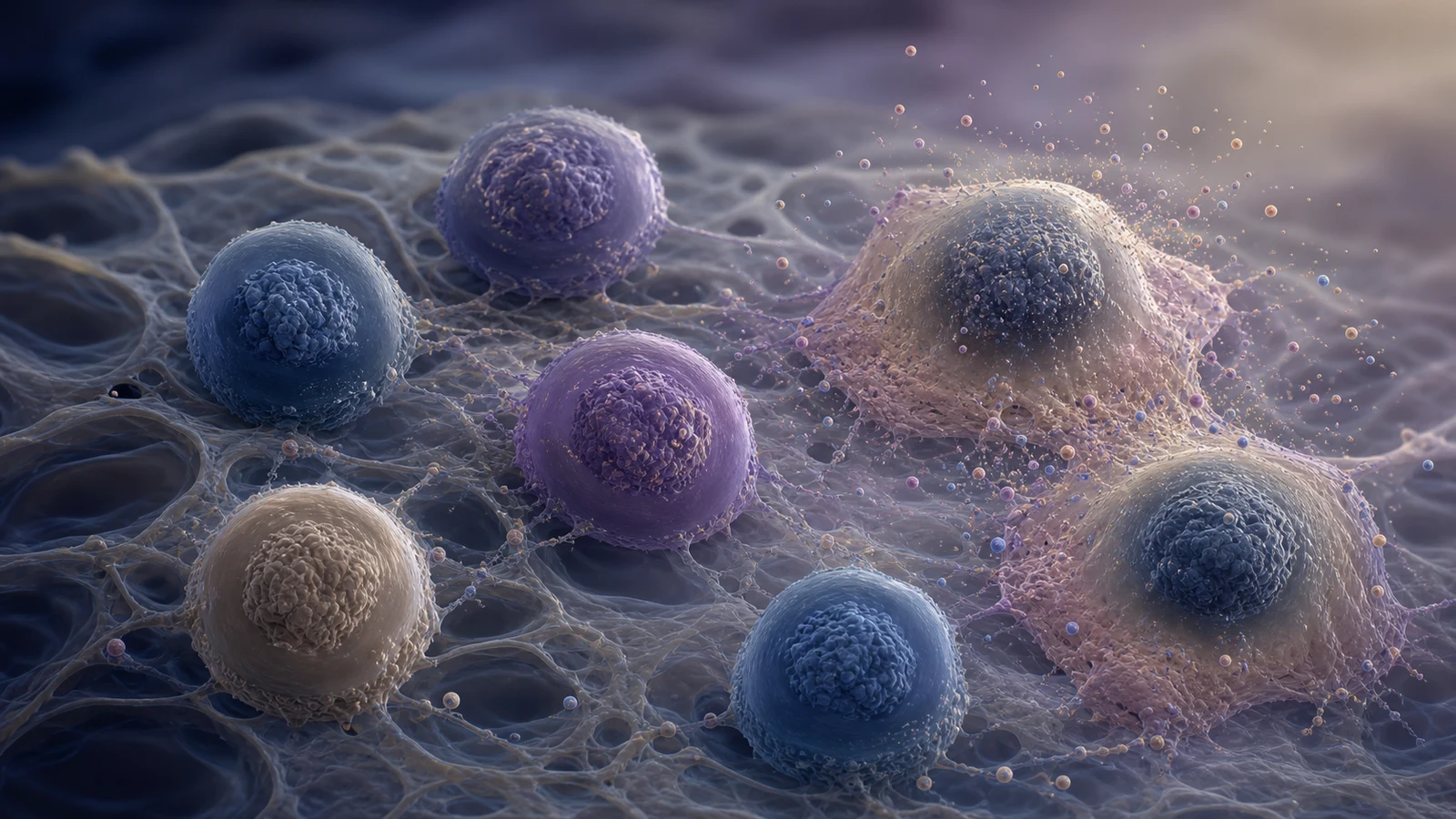
Cellular senescence has become a prominent idea in longevity science. The shorthand is appealing: damaged cells stop dividing, linger in tissues, release inflammatory signals and contribute to ageing. Remove those cells, the story goes, and perhaps healthier life can be extended.
That summary contains real biology, but it is too simple for clinical conclusions. A major NIH-supported research release in June 2026 reinforces a more careful view. Senescence is not one uniform cell type, not always harmful, and not yet a validated treatment target for otherwise healthy people.
What cellular senescence actually means
Senescence is a cellular state usually triggered by stress such as DNA damage, oncogene activation, metabolic disruption or repeated replication. A senescent cell enters a durable cell-cycle arrest: it remains metabolically active but no longer divides in the usual way.
This can be protective. Arresting a damaged cell may stop it from passing unstable DNA to daughter cells. Senescent states also participate in development, tissue repair and wound healing. The problem is not simply that senescent cells exist. It is that some persist, accumulate or signal in ways that may disturb their local tissue environment.
Some senescent cells develop a senescence-associated secretory phenotype, or SASP. This can include cytokines, growth factors and tissue-remodelling molecules. In laboratory systems, those signals can affect inflammation, immune surveillance and neighbouring cells. That is a mechanistic finding: it explains how senescence could influence tissue function. It does not, by itself, show that clearing senescent cells improves health in people.
The new atlas changes the picture
The NIH Cellular Senescence Network, known as SenNet, is mapping these cells across human tissues using single-cell, spatial and molecular methods. Its 2026 framework introduces the idea of different “senotypes”: senescent states shaped by the cell of origin, tissue, health context and surrounding environment.
This matters because researchers have not found one universal marker that identifies every senescent cell and excludes every other cell. A marker that works in cultured fibroblasts may not behave the same way in a lymph node, lung or brain. Cells can also display some features of senescence without meeting every proposed criterion.
The atlas is an important research advance, but it is not a clinical test. Associations between molecular signatures and outcomes such as frailty or disease risk require validation across populations, laboratories and time. Predicting an outcome is also different from showing that changing the marker changes the outcome.
What the preclinical evidence shows
Animal studies provide strong proof of principle. In a widely cited 2018 study, transplanting relatively small numbers of senescent cells into mice produced persistent physical dysfunction. Experimental clearance of senescent cells in naturally aged mice improved measures of physical function and post-treatment survival.
That study supports a causal role for particular senescent cells in those models. It also provides a rational basis for testing senolytic drugs, which are designed to preferentially eliminate senescent cells.
But mice are not small humans. The experimental cells, doses, disease models and lifespan are different. A result in aged or genetically modified mice cannot establish that a treatment will extend healthspan, prevent disease or be safe in healthy adults.
Human clinical evidence remains early
Human studies have so far been small and mostly focused on people with specific diseases, not healthy ageing. A 2023 randomised pilot trial tested an experimental senolytic combination in 12 people with idiopathic pulmonary fibrosis. Its main purpose was feasibility and tolerability, not proof of efficacy.
The study was too small to determine clinical benefit. Measures of frailty, lung function and physical function did not appear meaningfully different between groups, and non-serious adverse events were more numerous in the active-treatment group. The authors called for larger trials to establish safety and efficacy.
This distinction is essential. Evidence that a compound affects a target is not evidence that it improves how a person feels, functions or survives. Evidence in a serious disease also cannot be transferred automatically to healthy adults. Current reviews describe multiple early-phase trials, but reliable patient selection, target-engagement markers, dosing, long-term safety and meaningful clinical endpoints remain unresolved.
A useful way to read senescence claims
When a headline says a product “clears ageing cells”, four questions help:
- Was the finding made in cultured cells, animals or humans?
- Was the study designed to measure a clinical benefit, or only a biomarker?
- Were participants healthy, or living with a specific disease?
- Were benefits and harms assessed in a sufficiently large, controlled trial?
For now, cellular senescence is a valuable research framework and a plausible therapeutic target. It is not a diagnosis, a routine screening category or a proven route to longer healthy life. The most credible work is moving towards precision: identifying which senescent states are harmful, in which tissues, at what time, and whether they can be modified without removing beneficial functions.
Sources
- NIH: SenNet framework and human cellular senescence atlas (2026)
- Cell: Charting human cellular senescence in aging and disease (2026)
- Nature Medicine: preclinical senolytic proof-of-concept study (2018)
- EBioMedicine: randomised pilot senolytic trial in pulmonary fibrosis (2023)
Evidence note: This Insight is general education, not medical advice. Senolytic therapies remain experimental; no treatment, supplement, diagnostic test or individual clinical decision is recommended here.