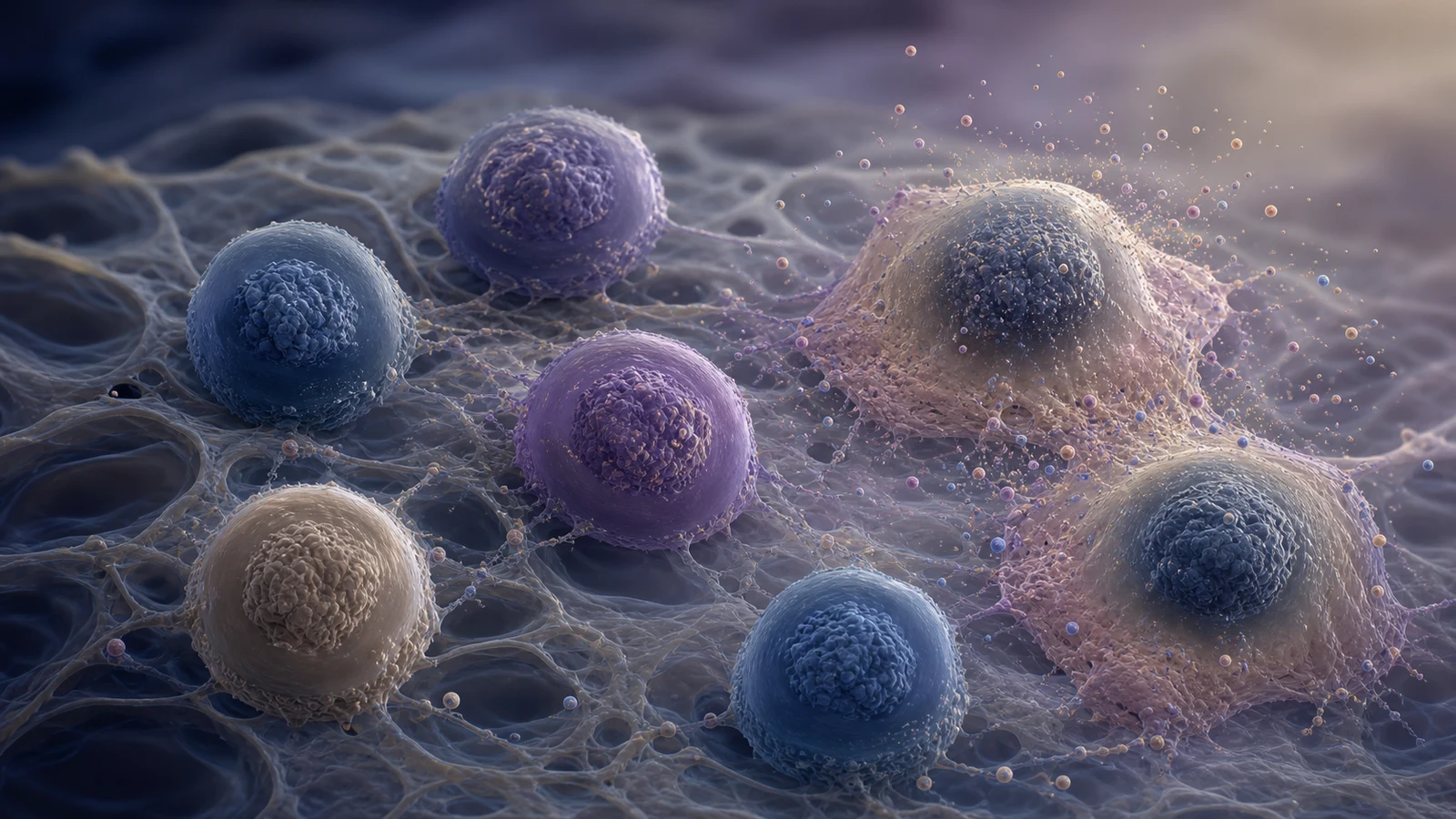
Our blood is renewed throughout life by stem cells in the bone marrow. Most of the time, thousands of these cells contribute to a diverse blood-cell population. With age, however, one stem cell can acquire a DNA change that gives its descendants a small competitive advantage. That lineage may gradually account for a detectable share of circulating blood cells.
This is called clonal haematopoiesis. When the acquired change is in a gene associated with blood cancer, the clone reaches a conventional reporting threshold, blood counts are not persistently abnormal and no haematological cancer is present, the finding may be called clonal haematopoiesis of indeterminate potential, or CHIP.
The name can sound alarming. The evidence requires a calmer distinction: CHIP is not an inherited genetic result, and it is not a diagnosis of leukaemia. It is a heterogeneous marker of altered blood-cell production whose significance varies considerably.
An acquired clone is not the genome you were born with
A CHIP mutation is somatic. It arose in one blood-forming stem cell during life and was copied into that cell’s descendants. It is therefore different from a germline variant present throughout the body and potentially shared within a family.
The traditional CHIP definition uses a variant allele frequency of at least 2 per cent. In simple terms, that estimates how much of the sampled blood carries the variant. The threshold is partly practical: more sensitive sequencing can find much smaller clones in many older adults, and detection alone does not establish clinical importance.
A 2024 analysis of whole-blood sequencing from 200,618 UK Biobank participants illustrates the complexity. Researchers identified additional genes under positive selection and found that clone frequency and size increased with age. The study expands the map of clonal haematopoiesis; it does not turn every detected clone into a disease or a treatment target.
Risk is not carried by the acronym alone
Population studies associate CHIP with a higher risk of blood cancers and several non-cancer outcomes. A 2024 systematic review of 88 studies found associations with haematological malignancy, cardiovascular events and other outcomes. It also found important heterogeneity between studies. Gene, clone size, population and measurement method changed the picture.
That variation matters clinically. A single small clone involving a commonly observed gene does not carry the same implications as several co-occurring changes, a larger clone or abnormal blood counts. A 2026 biobank study of more than 546,000 participants found that co-occurring forms of clonal haematopoiesis were uncommon but carried substantially higher blood-cancer risk than an isolated finding. Most people with detectable clonal haematopoiesis still did not develop a haematological malignancy.
Relative risk can also sound more dramatic than absolute risk. A risk marker may meaningfully separate groups in a large cohort while remaining a poor forecast for one person. This is why a gene name, reported percentage or online risk table should not be interpreted in isolation.
The inflammatory mechanism is plausible, not a treatment instruction
Some CHIP-associated mutations alter how immune cells behave. Experimental models suggest that selected clones can produce more inflammatory signalling, while an inflammatory environment can give certain mutant stem cells a further growth advantage. This two-way relationship is one proposed link between clonal haematopoiesis and cardiovascular disease.
These are mechanistic and preclinical findings. Human observational studies support associations, but they do not prove that removing a clone or blocking one inflammatory pathway will improve outcomes in an otherwise well person. Different mutations may act through different pathways, and targeted approaches remain an active research area rather than established healthy-ageing treatment.
How to read an incidental finding
CHIP may be found during blood sequencing performed for research, cancer care or another clinical question. A useful interpretation starts with context rather than the headline:
- Was the variant acquired in blood cells or present throughout the body?
- Why was sequencing performed, and was the test validated for this use?
- Which gene is involved, how large is the clone and are there multiple changes?
- Are blood counts stable, and is there a relevant treatment or medical history?
- Would any proposed follow-up change a meaningful clinical decision?
For now, clonal haematopoiesis is best understood as an ageing-related spectrum. It can reveal genuine biology and help researchers identify higher-risk subgroups, but it is not a consumer biological-age score, a reason for indiscriminate screening or a diagnosis from one number. The practical value lies in careful classification, proportionate communication and evidence that a result is actionable—not in finding more mutations for their own sake.
Sources
- Nature Reviews Molecular Cell Biology: inflammageing and clonal haematopoiesis (2026)
- Nature Genetics: somatic mutations in whole blood from 200,618 participants (2024)
- Blood Advances: systematic review and meta-analysis of CHIP as a prognostic factor (2024)
- Nature Communications: co-occurring clonal haematopoiesis in biobank data (2026)
Evidence note: This Insight is general education, not medical advice. It does not recommend genetic screening, diagnose a blood disorder or replace interpretation by a qualified clinician who knows the reason for testing and the wider clinical context.